

×
A logical existence claim opening to reveal a witness, an algorithm, and a machine-checkable proof object.

Why Constructive Mathematics Feels at Home in a Proof Assistant

Existence as evidence, proofs as programs, and the practical reasons many formalizers begin without classical logic

Suppose a mathematician proves that a program always has a valid recovery action. An engineer may reasonably ask: which action? Can it be computed from the current state? How much time does the computation take? Does the proof identify an implementation, or does it merely rule out the possibility that no implementation exists?

Classical mathematics often treats these as separate questions. A theorem can establish that an object exists without exhibiting it. A later algorithmic problem asks how to find one.

Constructive mathematics draws the boundary differently. To prove that an object exists is, in the characteristic constructive reading, to provide a witness together with evidence that it has the required property. To prove that one statement implies another is to provide a method transforming evidence for the first into evidence for the second. Logical structure begins to resemble the interface of a program.

That resemblance helps explain why constructive ideas are disproportionately visible among users of proof assistants based on dependent type theory. It is not because all formalizers share one philosophy of mathematics, and it is not because classical mathematics is somehow incompatible with computers. Several major proof assistants—including HOL, Isabelle/HOL, PVS, and ACL2—are thoroughly classical. Lean and Rocq support classical reasoning; even strongly constructive developments may invoke it when computation is irrelevant.

Constructive mathematics is popular because it offers a particularly direct answer to a proof assistant’s central engineering question:

What concrete object should the kernel check when a user claims to have proved something?

The constructive answer is often: check the evidence itself.

Key takeaway
Constructive foundations align logical meaning with data and computation. That makes them attractive for proof assistants, even to users who have no commitment to philosophical intuitionism.

“Constructive” is not a synonym for “algorithmic trick”

Constructive mathematics is a broad family of approaches rather than one fixed formal system. Its members differ on the nature of infinite objects, choice principles, continuity, impredicativity, and acceptable forms of definition. Brouwerian intuitionism, Bishop-style constructive mathematics, Martin-Löf type theory, constructive set theories, and realizability-based approaches are related but not identical.1

Their common theme is a stricter interpretation of mathematical assertion. The phrase “there exists an x such that P(x)” is not accepted merely because assuming the contrary leads to contradiction. A constructive proof should normally provide an x and establish P(x).

Likewise, a proof of

P or Q

should normally indicate which side holds and provide evidence for that side. A proof of

for every x, P(x)

should provide a uniform method producing evidence for P(x) from an arbitrary x.

These are not arbitrary restrictions. They define the meaning of the logical connectives in terms of what counts as evidence. The resulting account is commonly summarized by the Brouwer–Heyting–Kolmogorov, or BHK, interpretation.
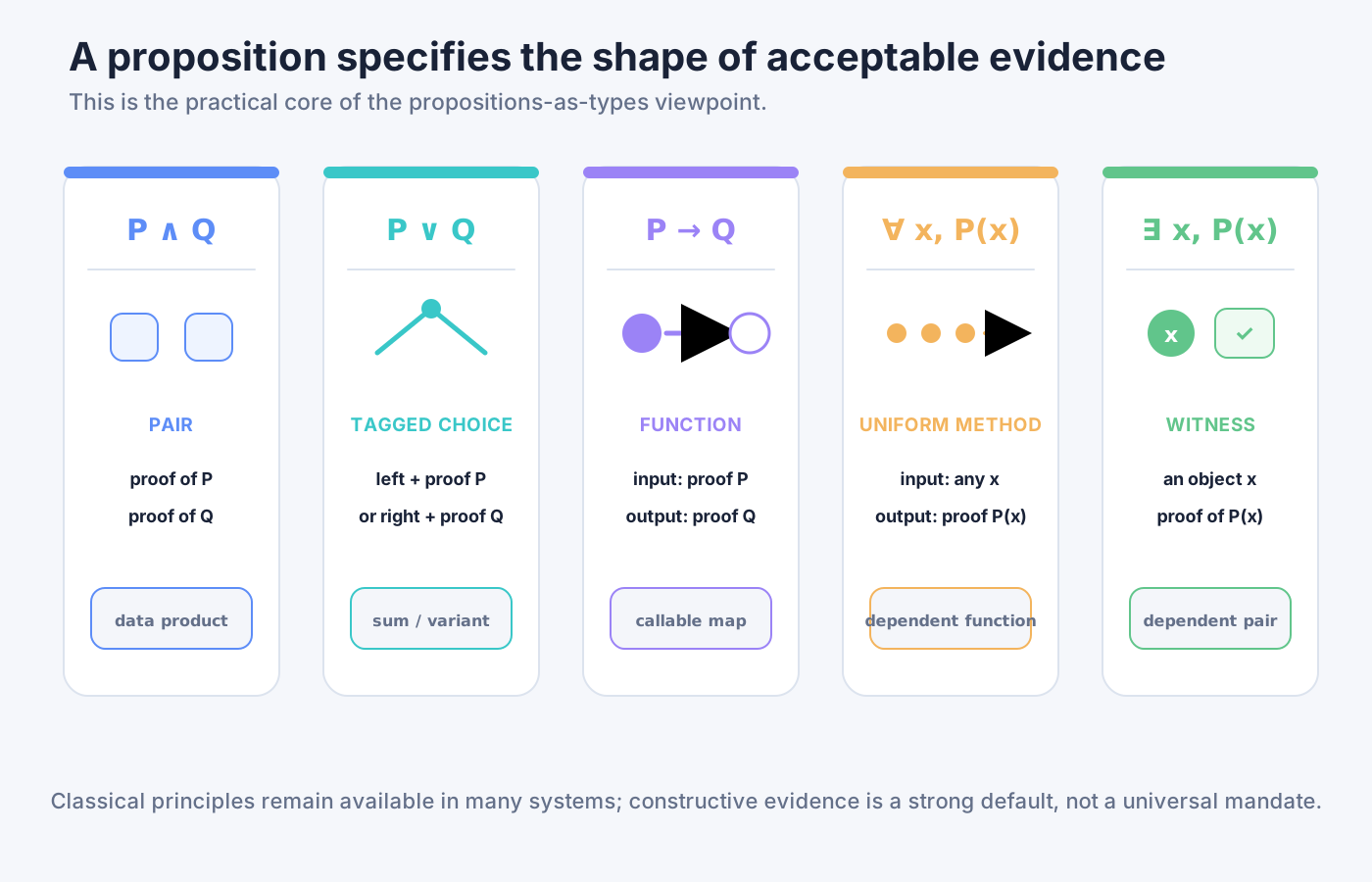
The constructive evidence expected for conjunction, disjunction, implication, universal quantification, and existence.

Constructive logic reads a proposition as a specification of the evidence required to establish it.

A short historical route: Brouwer, Bishop, and Martin-Löf

Constructive reasoning existed long before the term acquired its modern technical meaning. Euclid’s constructions, algorithms in number theory, and explicit solutions in algebra all have constructive character. The modern foundational movement arose in response to the increasingly abstract mathematics of the late nineteenth and early twentieth centuries.

Brouwer and intuitionism

L. E. J. Brouwer argued that mathematics is grounded in mental construction rather than in a preexisting universe of completed abstract objects. In his 1908 essay on the unreliability of logical principles, he challenged unrestricted use of the law of excluded middle—the assertion that every proposition P satisfies P or not P—when no method decides which alternative holds.2

Brouwer’s position was philosophically demanding and mathematically revisionary. He did not merely propose a useful programming discipline. He offered a different account of what mathematics is.

Modern proof-assistant users need not accept that philosophy to benefit from constructive logic. The logical discipline can be adopted for technical reasons: it tracks evidence, preserves computational meaning, and makes hidden uses of nonconstructive principles visible.

Bishop and constructive mainstream mathematics

In 1967, Errett Bishop published Foundations of Constructive Analysis. Bishop’s program was deliberately less tied to Brouwer’s philosophy. He aimed to show that substantial analysis could be developed using constructive methods in a style recognizable to working mathematicians.3

Bishop’s work changed the debate. Constructive mathematics was not only a foundational protest; it could be a positive mathematical practice. It often yielded results usable under several interpretations: classically, intuitionistically, or computationally.

Martin-Löf and type theory

Per Martin-Löf developed intuitionistic type theory as a foundation in which mathematical objects, propositions, and proofs are organized through types and computation. The published lecture notes Intuitionistic Type Theory became a major source for the systems that later influenced Nuprl, Agda, Rocq, and Lean.4

Type theory made constructive meaning exceptionally concrete. Instead of explaining evidence only in philosophical prose, it represented evidence as typed terms governed by formal construction and reduction rules.

This is where constructive mathematics and proof-assistant architecture began to fit together almost perfectly.

The logical connectives become data structures

The Curry–Howard correspondence links formal proofs with typed programs. Haskell Curry observed early correspondences between logical axioms and combinators; William Howard’s “formulae-as-types” account extended the connection to natural deduction and typed lambda calculus.5

At an introductory level, the correspondence can be read as a translation table:

Logic Type-theoretic evidence
P ∧ Q a pair containing a proof of P and a proof of Q
P ∨ Q a tagged choice: either a proof of P or a proof of Q
P → Q a function converting proofs of P into proofs of Q
∀ x, P(x) a function returning a proof of P(x) for each x
∃ x, P(x) a pair containing a witness x and a proof of P(x)
falsehood an empty type with no constructors

The correspondence is deeper than an analogy. The introduction and elimination rules of intuitionistic logic line up with constructors and function application. Simplifying a proof lines up with evaluating a program. A proposition is inhabited exactly when a corresponding proof term can be constructed.

Consider an existence theorem:

for every input n, there exists an output m such that Valid(n, m)

Under a constructive type-theoretic reading, a proof may be a function that accepts n and returns a pair:

(m, proof that Valid(n, m))

The witness and its certificate travel together. This is a natural interface for verified programming.

Common misconception: “Curry–Howard means every mathematical proof is automatically a fast program.”
No. The extracted computation may be inefficient, may contain irrelevant proof bookkeeping, or may live in a proposition universe whose terms are erased. Curry–Howard supplies computational structure; good algorithms still require good design.

The classical move constructive logic declines to make automatically

The best-known difference between classical and constructive logic is the law of excluded middle:

P ∨ ¬P

Classical logic accepts this for every proposition. Constructive logic accepts it when there is a method deciding P, but not as a universal principle without evidence.

A related classical principle is double-negation elimination:

¬¬P → P

Constructively, proving that P cannot be false is not always the same as producing evidence for P.

A famous elementary example shows the difference. We want to prove that there exist irrational numbers a and b such that a^b is rational. Let

c = (√2)^(√2).

Classically, either c is rational or it is irrational. If it is rational, choose a = b = √2. If it is irrational, choose a = c and b = √2; then a^b = 2. The argument proves existence without deciding which case actually holds.

The proof is elegant and valid classically. Constructively, it has not yet supplied a definite pair because it relies on a case distinction for which no decision procedure was given. A constructive proof would need more information.

This example captures the practical attraction of constructive statements. They often provide a stronger deliverable. A constructive existence proof can usually be read classically, but a classical existence proof may not contain a witness that a program can extract.

Why a proof assistant likes explicit evidence

A proof assistant must turn mathematical confidence into a finite checking process. Constructive type theory offers several advantages for that task.

1. The kernel checks objects, not intentions

A theorem is represented by a term with the theorem’s type. The kernel checks that the term is well typed according to a small collection of rules. It need not decide whether the surrounding prose was persuasive.

This does not require every proof to be handwritten as a raw term. Tactics, elaborators, simplifiers, and automated provers can construct terms on the user’s behalf. The final result remains checkable evidence.

2. Computation is part of equality

Type checkers for dependent type theory routinely determine that expressions are equal because they compute to the same result. For example, applying a recursively defined addition function to concrete numbers reduces to a numeral. This computational equality allows specifications and proofs to mention executable functions directly.

Constructive foundations are designed so that computation does not sit outside the logic as an informal implementation detail. Reduction is part of the theory’s meaning.

3. Existence can return a witness

When an existence theorem is represented by a dependent pair, the witness is literally a component of the proof object. A verified search algorithm can return a result together with evidence that the result satisfies its specification.

Rocq explicitly supports extracting executable programs from constructive developments.6 Agda presents itself as both a dependently typed programming language and a proof assistant, allowing constructive proofs to run as algorithms.7

4. Assumptions become trackable dependencies

A constructive base lets a library add classical principles where they are useful and record that dependence explicitly. A theorem proved without excluded middle remains valid in classical settings as well. A theorem using classical choice can be marked as such.

Lean’s documentation, for example, distinguishes constructive proof rules from classical principles such as Classical.em, and it can report the axioms on which a declaration depends.8 Rocq’s standard library similarly provides classical logic and choice in named modules rather than making every development silently rely on them.9

5. Logical precision can reveal missing specifications

Suppose a program specification says, “for every request, either the operation succeeds or it fails.” Classically, that statement is trivial. Constructively, proving it may require a decision procedure that inspects the request and determines the outcome.

The difficulty can be informative. It exposes a missing algorithm or an underspecified interface. A proof obligation is not only an obstacle; it can diagnose what the system has not yet defined.

Constructive does not mean refusing all case analysis

Proof-assistant newcomers sometimes imagine constructive logic as a world in which one may never write “either P or not P.” That is false.

For many propositions, excluded middle is constructively provable because the proposition is decidable. Equality of two machine integers can be computed. Membership in a finite list can be searched. A Boolean circuit either produces true or false. Once a decision procedure is available, the proof can branch on its result.

The constructive distinction is therefore not “case analysis versus no case analysis.” It is:

  • local, justified decisions, backed by data or an algorithm;
  • versus a global logical axiom declaring every proposition decidable whether or not a decision method is known.

This locality is useful in verification. It encourages libraries to package decision procedures with proofs of their correctness. Automation can then use classical-looking reasoning in domains where it is computationally justified.

Constructive proofs are often more portable

A theorem established constructively can normally be used in a classical environment because classical logic extends intuitionistic logic. The reverse translation may require additional work or yield a weaker computational result.

This gives constructive proofs a form of portability. They can support:

  • ordinary mathematical use;
  • program extraction;
  • interpretation in different constructive models;
  • use in foundations with or without selected classical axioms;
  • and, in some cases, quantitative information hidden by a purely classical proof.

Constructive analysis sometimes replaces a yes-or-no statement with an approximation procedure or a modulus describing how fast a sequence converges. At first this may look cumbersome. In numerical computation, it can be exactly the information an implementation needs.

Key takeaway
Constructive reasoning often strengthens a theorem from “an object cannot fail to exist” to “here is controlled evidence from which the object can be obtained.”

Not every proof assistant is constructive

The relationship between constructivism and proof assistants is strong, but it is not universal.

Classical systems are central to the field

The HOL family is based on classical higher-order logic. Isabelle/HOL explicitly describes itself as a version of classical higher-order logic.10 PVS uses classical typed higher-order logic. ACL2 uses a classical first-order logic tailored to executable Common Lisp functions.

These systems have produced major verification results. Their success decisively refutes the idea that machine checking requires constructive foundations.

Constructive systems often permit classical reasoning

Rocq’s foundational calculus is constructive, but its library includes modules for excluded middle, choice, extensionality, and other classical principles. Agda users can declare postulates, although Safe Agda forbids them to prevent accidental inconsistency.11 Lean provides classical choice and excluded middle through named declarations; definitions depending on choice may be marked noncomputable when executable code cannot be generated.12

The practical pattern is often constructive by default, classical by explicit choice.

“Proofs as programs” also has classical extensions

The Curry–Howard correspondence has interpretations for classical logic, often involving control operators or continuation-passing transformations. Constructive logic is not the only logic with computational semantics. It is simply the most direct setting in which ordinary functions, pairs, sums, and dependent pairs mirror logical rules.

The limits and costs of constructive practice

Constructive mathematics is not a free upgrade.

Some classical proofs are dramatically shorter

A proof by contradiction may avoid the need to construct a complicated witness. The axiom of choice can produce global selections without defining an algorithm. In fields where only truth matters, the constructive version may demand work that brings little practical benefit.

Familiar definitions may need redesign

Classical mathematics often defines objects using arbitrary representatives, quotient sets, or least elements known to exist. Constructive formalization may require setoids, explicit equivalence relations, higher inductive quotients, apartness relations, or additional decidability hypotheses.

Computational content may be unusable

A proof can encode an algorithm with terrible complexity. It may search an enormous space, carry large certificates, or rely on high-level mathematical representations inappropriate for runtime use. Extraction is not optimization.

Proof erasure complicates the slogan

Many proof assistants distinguish computational data from propositions whose proofs are erased. In Rocq and Lean, not every proof term is intended to survive compilation. This separation is valuable: runtime programs should not carry irrelevant evidence. It also means that “proofs are programs” must be applied with attention to the system’s universe and erasure rules.

Constructive mathematics is itself plural

A statement acceptable in Bishop-style mathematics may use principles rejected by strict Brouwerian intuitionism, and a theorem formalized in Martin-Löf type theory may depend on choices about universes, identity, or inductive definitions. “Constructive” does not identify one universally agreed foundation.

Common misconception: “Constructive mathematics is classical mathematics with excluded middle deleted.”
It changes the intended meaning of proof and often changes the useful formulation of a theorem. Approximation data, witnesses, moduli, and decision procedures are positive structure, not merely compensation for a missing axiom.

Why practitioners keep returning to it

The popularity of constructive foundations among proof-assistant users is best understood as an alignment of incentives.

A formalizer already has to make objects explicit. Constructive logic rewards that effort by turning explicit evidence into the meaning of the theorem. A type checker already evaluates terms. Constructive type theory makes that evaluation part of proof checking. A verification engineer wants artifacts that compose. Witness-carrying proofs and typed functions compose naturally. A library maintainer wants assumptions visible. Constructive defaults let classical dependencies be localized.

There is also a methodological benefit. Beginning constructively postpones irreversible commitments. If a proof succeeds without global excluded middle or choice, it can be used in more settings and may contain more information. If the constructive route becomes unreasonable, the missing classical principle can be introduced deliberately.

This resembles a software-engineering rule: start with the weakest interface that meets the requirement. Stronger assumptions can be added later; removing them from a large development is harder.

A practical mental map

When reading a formal theorem, ask four questions:

  1. What counts as evidence?
    Does an existence theorem contain a witness, or only a proposition in an erased universe?

  2. Which principles are assumed?
    Does the theorem depend on excluded middle, choice, function extensionality, quotients, or other axioms?

  3. What computes?
    Can the witness be evaluated, extracted, or compiled? Are some definitions marked noncomputable?

  4. What is the intended use?
    Is the goal an executable algorithm, a mathematical theorem, a safety certificate, or a reusable library fact?

These questions are more informative than simply labeling a system “constructive” or “classical.”
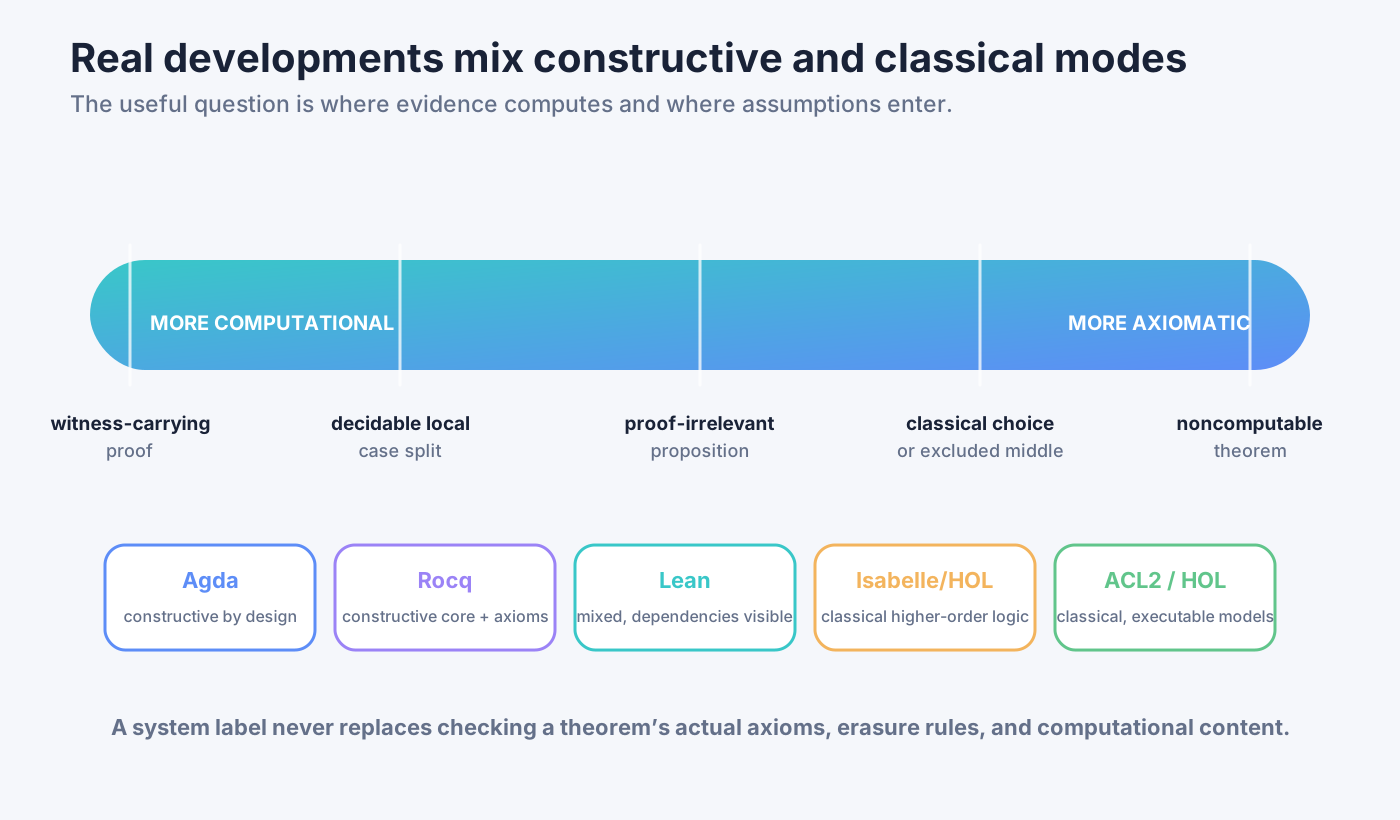
A spectrum of proof-assistant practice from constructive data-bearing proofs to explicitly classical, noncomputational theorems.

Most real proof developments mix modes. The important issue is not ideological purity but whether computational content and assumptions are visible where they matter.

Construction as an engineering virtue

Constructive mathematics entered the twentieth century as a foundational challenge. In proof assistants, it acquired an additional identity: a disciplined interface between logic and computation.

Its appeal is therefore partly philosophical, partly mathematical, and partly architectural. It offers a semantics in which a proof is not a mysterious mark of truth but a structured object. It gives existential claims a natural place to store witnesses. It lets reduction justify equalities. It supports verified programming and assumption tracking. It also leaves room for classical reasoning when the application calls for it.

The result is not a victory of one school over another. Classical proof remains indispensable, and classical proof assistants remain central. The constructive contribution is a powerful default question:

What evidence would make this claim true in a way a machine can inspect and, when appropriate, execute?

That question is unusually productive in formal verification. It turns logic from a language of conclusions into a language of interfaces—and turns many proofs into artifacts that can be combined, transformed, and run.

Final takeaway
Constructive mathematics is common in proof-assistant practice because it makes the content of a proof explicit. Its popularity comes less from rejecting classical mathematics than from offering a precise bridge between specification, evidence, and computation.

References


  1. Douglas Bridges and Fred Richman, “Constructive Mathematics,” Stanford Encyclopedia of Philosophy, substantive revision 2022. Authoritative overview. ↩︎

  2. L. E. J. Brouwer, “The Unreliability of the Logical Principles” (1908); modern English translation and historical introduction by Mark van Atten and Göran Sundholm, History and Philosophy of Logic 38(1), 2017, pp. 24–47. DOI. ↩︎

  3. Errett Bishop, Foundations of Constructive Analysis, McGraw-Hill, 1967. Bibliographic record and historical description in Bishop and Bridges, Constructive Analysis, Springer, 1985. Springer record. ↩︎

  4. Per Martin-Löf, Intuitionistic Type Theory: Notes by Giovanni Sambin of a Series of Lectures Given in Padua, June 1980, Bibliopolis, 1984; open digital edition, 2021. Open Research Online. ↩︎

  5. William A. Howard, “The Formulae-as-Types Notion of Construction,” in To H. B. Curry: Essays on Combinatory Logic, Lambda Calculus and Formalism, Academic Press, 1980, pp. 479–490. Bibliographic record. ↩︎

  6. Rocq project, “Welcome to a World of Rocq,” describing Rocq as an interactive theorem prover and dependently typed programming language with program extraction. Official site. ↩︎

  7. Agda development team, “What Is Agda?” Agda 2.9 documentation. Official documentation. ↩︎

  8. Lean project, “Propositions and Proofs,” section on constructive and classical logic. Theorem Proving in Lean 4. ↩︎

  9. Rocq project, “Standard Library,” listing constructive and classical logic modules, choice principles, and extensionality axioms. Official standard-library index. ↩︎

  10. Isabelle project, “The Isabelle2025-2 Library,” identifying Isabelle/HOL as classical higher-order logic. Official library. ↩︎

  11. Agda development team, “Postulates,” including the warning that postulates can threaten consistency and are forbidden in Safe Agda. Official documentation. ↩︎

  12. Lean project, “Axioms and Computation,” explaining classical choice, excluded middle, and why definitions depending on choice may be noncomputable. Theorem Proving in Lean 4. ↩︎

Skip to content

Learn

Why Constructive Mathematics Feels at Home in a Proof Assistant

Constructive mathematics does not merely forbid a few classical proof techniques. It interprets logical statements as demands for explicit evidence, an interpretation that aligns unusually well with typed programs and machine-checked proofs.

Suppose a mathematician proves that a program always has a valid recovery action. An engineer may reasonably ask: which action? Can it be computed from the current state? How much time does the computation take? Does the proof identify an implementation, or does it merely rule out the possibility that no implementation exists?

Classical mathematics often treats these as separate questions. A theorem can establish that an object exists without exhibiting it. A later algorithmic problem asks how to find one.

Constructive mathematics draws the boundary differently. To prove that an object exists is, in the characteristic constructive reading, to provide a witness together with evidence that it has the required property. To prove that one statement implies another is to provide a method transforming evidence for the first into evidence for the second. Logical structure begins to resemble the interface of a program.

That resemblance helps explain why constructive ideas are disproportionately visible among users of proof assistants based on dependent type theory. It is not because all formalizers share one philosophy of mathematics, and it is not because classical mathematics is somehow incompatible with computers. Several major proof assistants—including HOL, Isabelle/HOL, PVS, and ACL2—are thoroughly classical. Lean and Rocq support classical reasoning; even strongly constructive developments may invoke it when computation is irrelevant.

Constructive mathematics is popular because it offers a particularly direct answer to a proof assistant’s central engineering question:

What concrete object should the kernel check when a user claims to have proved something?

The constructive answer is often: check the evidence itself.

Key takeaway
Constructive foundations align logical meaning with data and computation. That makes them attractive for proof assistants, even to users who have no commitment to philosophical intuitionism.

“Constructive” is not a synonym for “algorithmic trick”

Constructive mathematics is a broad family of approaches rather than one fixed formal system. Its members differ on the nature of infinite objects, choice principles, continuity, impredicativity, and acceptable forms of definition. Brouwerian intuitionism, Bishop-style constructive mathematics, Martin-Löf type theory, constructive set theories, and realizability-based approaches are related but not identical.1

Their common theme is a stricter interpretation of mathematical assertion. The phrase “there exists an x such that P(x)” is not accepted merely because assuming the contrary leads to contradiction. A constructive proof should normally provide an x and establish P(x).

Likewise, a proof of

P or Q

should normally indicate which side holds and provide evidence for that side. A proof of

for every x, P(x)

should provide a uniform method producing evidence for P(x) from an arbitrary x.

These are not arbitrary restrictions. They define the meaning of the logical connectives in terms of what counts as evidence. The resulting account is commonly summarized by the Brouwer–Heyting–Kolmogorov, or BHK, interpretation.

The constructive evidence expected for conjunction, disjunction, implication, universal quantification, and existence.

Constructive logic reads a proposition as a specification of the evidence required to establish it.

A short historical route: Brouwer, Bishop, and Martin-Löf

Constructive reasoning existed long before the term acquired its modern technical meaning. Euclid’s constructions, algorithms in number theory, and explicit solutions in algebra all have constructive character. The modern foundational movement arose in response to the increasingly abstract mathematics of the late nineteenth and early twentieth centuries.

Brouwer and intuitionism

L. E. J. Brouwer argued that mathematics is grounded in mental construction rather than in a preexisting universe of completed abstract objects. In his 1908 essay on the unreliability of logical principles, he challenged unrestricted use of the law of excluded middle—the assertion that every proposition P satisfies P or not P—when no method decides which alternative holds.2

Brouwer’s position was philosophically demanding and mathematically revisionary. He did not merely propose a useful programming discipline. He offered a different account of what mathematics is.

Modern proof-assistant users need not accept that philosophy to benefit from constructive logic. The logical discipline can be adopted for technical reasons: it tracks evidence, preserves computational meaning, and makes hidden uses of nonconstructive principles visible.

Bishop and constructive mainstream mathematics

In 1967, Errett Bishop published Foundations of Constructive Analysis. Bishop’s program was deliberately less tied to Brouwer’s philosophy. He aimed to show that substantial analysis could be developed using constructive methods in a style recognizable to working mathematicians.3

Bishop’s work changed the debate. Constructive mathematics was not only a foundational protest; it could be a positive mathematical practice. It often yielded results usable under several interpretations: classically, intuitionistically, or computationally.

Martin-Löf and type theory

Per Martin-Löf developed intuitionistic type theory as a foundation in which mathematical objects, propositions, and proofs are organized through types and computation. The published lecture notes Intuitionistic Type Theory became a major source for the systems that later influenced Nuprl, Agda, Rocq, and Lean.4

Type theory made constructive meaning exceptionally concrete. Instead of explaining evidence only in philosophical prose, it represented evidence as typed terms governed by formal construction and reduction rules.

This is where constructive mathematics and proof-assistant architecture began to fit together almost perfectly.

The logical connectives become data structures

The Curry–Howard correspondence links formal proofs with typed programs. Haskell Curry observed early correspondences between logical axioms and combinators; William Howard’s “formulae-as-types” account extended the connection to natural deduction and typed lambda calculus.5

At an introductory level, the correspondence can be read as a translation table:

Logic Type-theoretic evidence
P ∧ Q a pair containing a proof of P and a proof of Q
P ∨ Q a tagged choice: either a proof of P or a proof of Q
P → Q a function converting proofs of P into proofs of Q
∀ x, P(x) a function returning a proof of P(x) for each x
∃ x, P(x) a pair containing a witness x and a proof of P(x)
falsehood an empty type with no constructors

The correspondence is deeper than an analogy. The introduction and elimination rules of intuitionistic logic line up with constructors and function application. Simplifying a proof lines up with evaluating a program. A proposition is inhabited exactly when a corresponding proof term can be constructed.

Consider an existence theorem:

for every input n, there exists an output m such that Valid(n, m)

Under a constructive type-theoretic reading, a proof may be a function that accepts n and returns a pair:

(m, proof that Valid(n, m))

The witness and its certificate travel together. This is a natural interface for verified programming.

Common misconception: “Curry–Howard means every mathematical proof is automatically a fast program.”
No. The extracted computation may be inefficient, may contain irrelevant proof bookkeeping, or may live in a proposition universe whose terms are erased. Curry–Howard supplies computational structure; good algorithms still require good design.

The classical move constructive logic declines to make automatically

The best-known difference between classical and constructive logic is the law of excluded middle:

P ∨ ¬P

Classical logic accepts this for every proposition. Constructive logic accepts it when there is a method deciding P, but not as a universal principle without evidence.

A related classical principle is double-negation elimination:

¬¬P → P

Constructively, proving that P cannot be false is not always the same as producing evidence for P.

A famous elementary example shows the difference. We want to prove that there exist irrational numbers a and b such that a^b is rational. Let

c = (√2)^(√2).

Classically, either c is rational or it is irrational. If it is rational, choose a = b = √2. If it is irrational, choose a = c and b = √2; then a^b = 2. The argument proves existence without deciding which case actually holds.

The proof is elegant and valid classically. Constructively, it has not yet supplied a definite pair because it relies on a case distinction for which no decision procedure was given. A constructive proof would need more information.

This example captures the practical attraction of constructive statements. They often provide a stronger deliverable. A constructive existence proof can usually be read classically, but a classical existence proof may not contain a witness that a program can extract.

Why a proof assistant likes explicit evidence

A proof assistant must turn mathematical confidence into a finite checking process. Constructive type theory offers several advantages for that task.

1. The kernel checks objects, not intentions

A theorem is represented by a term with the theorem’s type. The kernel checks that the term is well typed according to a small collection of rules. It need not decide whether the surrounding prose was persuasive.

This does not require every proof to be handwritten as a raw term. Tactics, elaborators, simplifiers, and automated provers can construct terms on the user’s behalf. The final result remains checkable evidence.

2. Computation is part of equality

Type checkers for dependent type theory routinely determine that expressions are equal because they compute to the same result. For example, applying a recursively defined addition function to concrete numbers reduces to a numeral. This computational equality allows specifications and proofs to mention executable functions directly.

Constructive foundations are designed so that computation does not sit outside the logic as an informal implementation detail. Reduction is part of the theory’s meaning.

3. Existence can return a witness

When an existence theorem is represented by a dependent pair, the witness is literally a component of the proof object. A verified search algorithm can return a result together with evidence that the result satisfies its specification.

Rocq explicitly supports extracting executable programs from constructive developments.6 Agda presents itself as both a dependently typed programming language and a proof assistant, allowing constructive proofs to run as algorithms.7

4. Assumptions become trackable dependencies

A constructive base lets a library add classical principles where they are useful and record that dependence explicitly. A theorem proved without excluded middle remains valid in classical settings as well. A theorem using classical choice can be marked as such.

Lean’s documentation, for example, distinguishes constructive proof rules from classical principles such as Classical.em, and it can report the axioms on which a declaration depends.8 Rocq’s standard library similarly provides classical logic and choice in named modules rather than making every development silently rely on them.9

5. Logical precision can reveal missing specifications

Suppose a program specification says, “for every request, either the operation succeeds or it fails.” Classically, that statement is trivial. Constructively, proving it may require a decision procedure that inspects the request and determines the outcome.

The difficulty can be informative. It exposes a missing algorithm or an underspecified interface. A proof obligation is not only an obstacle; it can diagnose what the system has not yet defined.

Constructive does not mean refusing all case analysis

Proof-assistant newcomers sometimes imagine constructive logic as a world in which one may never write “either P or not P.” That is false.

For many propositions, excluded middle is constructively provable because the proposition is decidable. Equality of two machine integers can be computed. Membership in a finite list can be searched. A Boolean circuit either produces true or false. Once a decision procedure is available, the proof can branch on its result.

The constructive distinction is therefore not “case analysis versus no case analysis.” It is:

  • local, justified decisions, backed by data or an algorithm;
  • versus a global logical axiom declaring every proposition decidable whether or not a decision method is known.

This locality is useful in verification. It encourages libraries to package decision procedures with proofs of their correctness. Automation can then use classical-looking reasoning in domains where it is computationally justified.

Constructive proofs are often more portable

A theorem established constructively can normally be used in a classical environment because classical logic extends intuitionistic logic. The reverse translation may require additional work or yield a weaker computational result.

This gives constructive proofs a form of portability. They can support:

  • ordinary mathematical use;
  • program extraction;
  • interpretation in different constructive models;
  • use in foundations with or without selected classical axioms;
  • and, in some cases, quantitative information hidden by a purely classical proof.

Constructive analysis sometimes replaces a yes-or-no statement with an approximation procedure or a modulus describing how fast a sequence converges. At first this may look cumbersome. In numerical computation, it can be exactly the information an implementation needs.

Key takeaway
Constructive reasoning often strengthens a theorem from “an object cannot fail to exist” to “here is controlled evidence from which the object can be obtained.”

Not every proof assistant is constructive

The relationship between constructivism and proof assistants is strong, but it is not universal.

Classical systems are central to the field

The HOL family is based on classical higher-order logic. Isabelle/HOL explicitly describes itself as a version of classical higher-order logic.10 PVS uses classical typed higher-order logic. ACL2 uses a classical first-order logic tailored to executable Common Lisp functions.

These systems have produced major verification results. Their success decisively refutes the idea that machine checking requires constructive foundations.

Constructive systems often permit classical reasoning

Rocq’s foundational calculus is constructive, but its library includes modules for excluded middle, choice, extensionality, and other classical principles. Agda users can declare postulates, although Safe Agda forbids them to prevent accidental inconsistency.11 Lean provides classical choice and excluded middle through named declarations; definitions depending on choice may be marked noncomputable when executable code cannot be generated.12

The practical pattern is often constructive by default, classical by explicit choice.

“Proofs as programs” also has classical extensions

The Curry–Howard correspondence has interpretations for classical logic, often involving control operators or continuation-passing transformations. Constructive logic is not the only logic with computational semantics. It is simply the most direct setting in which ordinary functions, pairs, sums, and dependent pairs mirror logical rules.

The limits and costs of constructive practice

Constructive mathematics is not a free upgrade.

Some classical proofs are dramatically shorter

A proof by contradiction may avoid the need to construct a complicated witness. The axiom of choice can produce global selections without defining an algorithm. In fields where only truth matters, the constructive version may demand work that brings little practical benefit.

Familiar definitions may need redesign

Classical mathematics often defines objects using arbitrary representatives, quotient sets, or least elements known to exist. Constructive formalization may require setoids, explicit equivalence relations, higher inductive quotients, apartness relations, or additional decidability hypotheses.

Computational content may be unusable

A proof can encode an algorithm with terrible complexity. It may search an enormous space, carry large certificates, or rely on high-level mathematical representations inappropriate for runtime use. Extraction is not optimization.

Proof erasure complicates the slogan

Many proof assistants distinguish computational data from propositions whose proofs are erased. In Rocq and Lean, not every proof term is intended to survive compilation. This separation is valuable: runtime programs should not carry irrelevant evidence. It also means that “proofs are programs” must be applied with attention to the system’s universe and erasure rules.

Constructive mathematics is itself plural

A statement acceptable in Bishop-style mathematics may use principles rejected by strict Brouwerian intuitionism, and a theorem formalized in Martin-Löf type theory may depend on choices about universes, identity, or inductive definitions. “Constructive” does not identify one universally agreed foundation.

Common misconception: “Constructive mathematics is classical mathematics with excluded middle deleted.”
It changes the intended meaning of proof and often changes the useful formulation of a theorem. Approximation data, witnesses, moduli, and decision procedures are positive structure, not merely compensation for a missing axiom.

Why practitioners keep returning to it

The popularity of constructive foundations among proof-assistant users is best understood as an alignment of incentives.

A formalizer already has to make objects explicit. Constructive logic rewards that effort by turning explicit evidence into the meaning of the theorem. A type checker already evaluates terms. Constructive type theory makes that evaluation part of proof checking. A verification engineer wants artifacts that compose. Witness-carrying proofs and typed functions compose naturally. A library maintainer wants assumptions visible. Constructive defaults let classical dependencies be localized.

There is also a methodological benefit. Beginning constructively postpones irreversible commitments. If a proof succeeds without global excluded middle or choice, it can be used in more settings and may contain more information. If the constructive route becomes unreasonable, the missing classical principle can be introduced deliberately.

This resembles a software-engineering rule: start with the weakest interface that meets the requirement. Stronger assumptions can be added later; removing them from a large development is harder.

A practical mental map

When reading a formal theorem, ask four questions:

  1. What counts as evidence?
    Does an existence theorem contain a witness, or only a proposition in an erased universe?

  2. Which principles are assumed?
    Does the theorem depend on excluded middle, choice, function extensionality, quotients, or other axioms?

  3. What computes?
    Can the witness be evaluated, extracted, or compiled? Are some definitions marked noncomputable?

  4. What is the intended use?
    Is the goal an executable algorithm, a mathematical theorem, a safety certificate, or a reusable library fact?

These questions are more informative than simply labeling a system “constructive” or “classical.”

A spectrum of proof-assistant practice from constructive data-bearing proofs to explicitly classical, noncomputational theorems.

Most real proof developments mix modes. The important issue is not ideological purity but whether computational content and assumptions are visible where they matter.

Construction as an engineering virtue

Constructive mathematics entered the twentieth century as a foundational challenge. In proof assistants, it acquired an additional identity: a disciplined interface between logic and computation.

Its appeal is therefore partly philosophical, partly mathematical, and partly architectural. It offers a semantics in which a proof is not a mysterious mark of truth but a structured object. It gives existential claims a natural place to store witnesses. It lets reduction justify equalities. It supports verified programming and assumption tracking. It also leaves room for classical reasoning when the application calls for it.

The result is not a victory of one school over another. Classical proof remains indispensable, and classical proof assistants remain central. The constructive contribution is a powerful default question:

What evidence would make this claim true in a way a machine can inspect and, when appropriate, execute?

That question is unusually productive in formal verification. It turns logic from a language of conclusions into a language of interfaces—and turns many proofs into artifacts that can be combined, transformed, and run.

Final takeaway
Constructive mathematics is common in proof-assistant practice because it makes the content of a proof explicit. Its popularity comes less from rejecting classical mathematics than from offering a precise bridge between specification, evidence, and computation.

References


  1. Douglas Bridges and Fred Richman, “Constructive Mathematics,” Stanford Encyclopedia of Philosophy, substantive revision 2022. Authoritative overview. ↩︎

  2. L. E. J. Brouwer, “The Unreliability of the Logical Principles” (1908); modern English translation and historical introduction by Mark van Atten and Göran Sundholm, History and Philosophy of Logic 38(1), 2017, pp. 24–47. DOI. ↩︎

  3. Errett Bishop, Foundations of Constructive Analysis, McGraw-Hill, 1967. Bibliographic record and historical description in Bishop and Bridges, Constructive Analysis, Springer, 1985. Springer record. ↩︎

  4. Per Martin-Löf, Intuitionistic Type Theory: Notes by Giovanni Sambin of a Series of Lectures Given in Padua, June 1980, Bibliopolis, 1984; open digital edition, 2021. Open Research Online. ↩︎

  5. William A. Howard, “The Formulae-as-Types Notion of Construction,” in To H. B. Curry: Essays on Combinatory Logic, Lambda Calculus and Formalism, Academic Press, 1980, pp. 479–490. Bibliographic record. ↩︎

  6. Rocq project, “Welcome to a World of Rocq,” describing Rocq as an interactive theorem prover and dependently typed programming language with program extraction. Official site. ↩︎

  7. Agda development team, “What Is Agda?” Agda 2.9 documentation. Official documentation. ↩︎

  8. Lean project, “Propositions and Proofs,” section on constructive and classical logic. Theorem Proving in Lean 4. ↩︎

  9. Rocq project, “Standard Library,” listing constructive and classical logic modules, choice principles, and extensionality axioms. Official standard-library index. ↩︎

  10. Isabelle project, “The Isabelle2025-2 Library,” identifying Isabelle/HOL as classical higher-order logic. Official library. ↩︎

  11. Agda development team, “Postulates,” including the warning that postulates can threaten consistency and are forbidden in Safe Agda. Official documentation. ↩︎

  12. Lean project, “Axioms and Computation,” explaining classical choice, excluded middle, and why definitions depending on choice may be noncomputable. Theorem Proving in Lean 4. ↩︎

Book a meetingStart a scoped conversation

Cabinet index

Explore Formal Foundry

Search the archive

Find a page

Type to search the published content.